Will a Shower Filter Reduce Your Water Pressure?
It is the first thing people ask, and it is a fair question. You are putting a filter cartridge in the path of your water, so something has to give. Here is the straight answer, including the cases where it genuinely might.
The short version
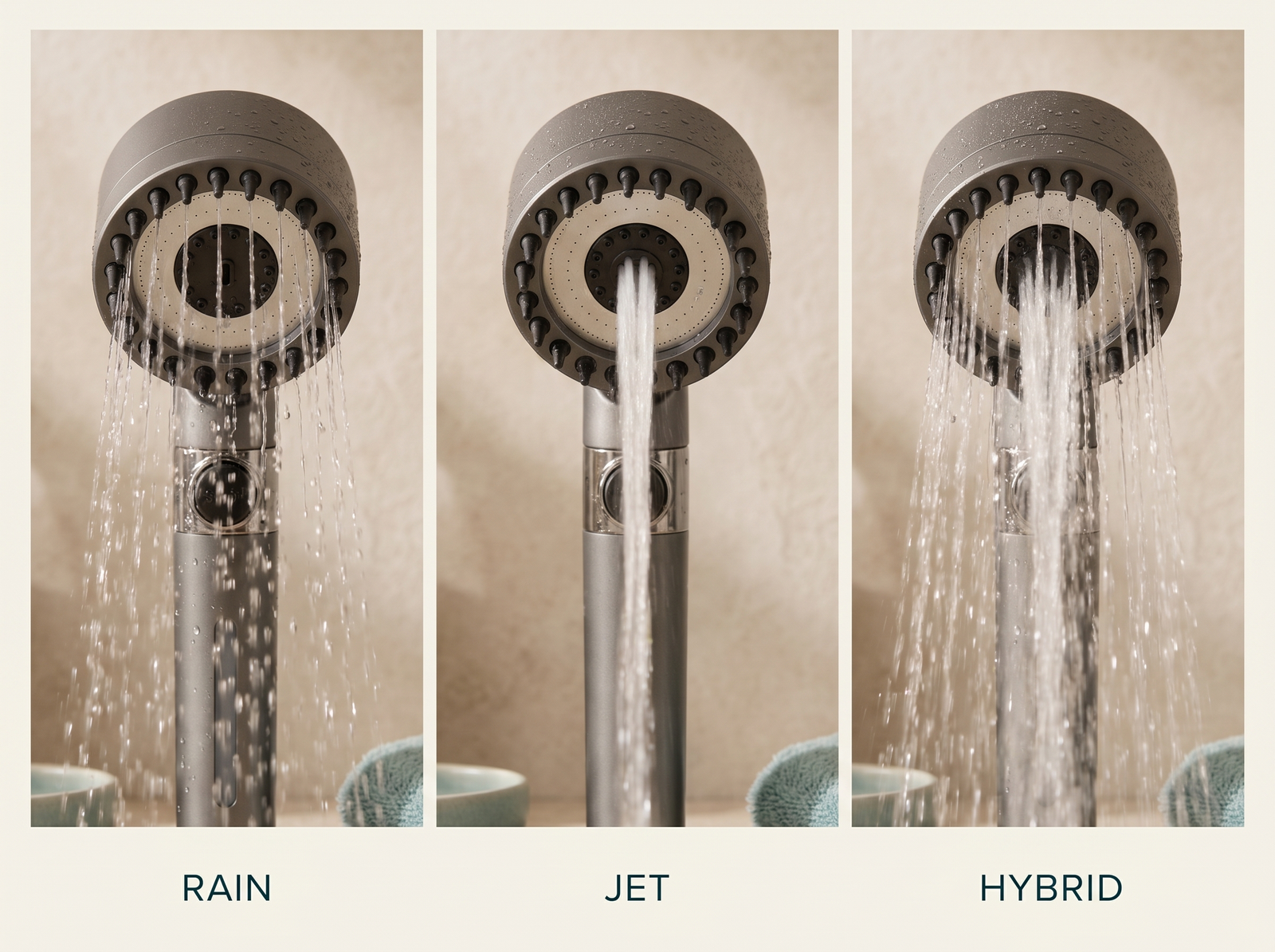
A filtered shower head does add a small amount of resistance. On a normal mains-pressure system you are unlikely to notice it, because the head's spray plate is doing far more to shape the feel of the water than the cartridge behind it. On a low-pressure or gravity-fed system, where you have less pressure to spare in the first place, any additional resistance is more noticeable.
What people usually describe as "the filter killed my pressure" is more often one of the three things below.
What actually causes weak shower flow
- A clogged cartridge left in too long. This is the big one. A filter that has done its job is full of the sediment it caught. Flow drops off gradually, so it is easy to miss until it is bad. Swapping the cartridge on schedule fixes it, and it is why replacement filters exist.
- Mineral build-up on the spray plate. Nozzles fur up over time. Most silicone-nozzle heads, ours included, let you rub the build-up off with a thumb.
- The system itself. An old hose with a kinked liner, a part-closed isolating valve, or a gravity-fed cylinder that was never going to deliver mains pressure. None of these are the filter's doing.
Some actual numbers, in units that apply here
Plenty has been written on this, but almost all of it is American, quoted in PSI, and measured against American household pressure. None of that helps you judge your own shower. Here is the arithmetic in the units New Zealand actually uses.
- Mains supply: a 200 kPa target. Watercare, which supplies Auckland and is the country's largest water supplier, publishes a minimum normal service target of 200 kilopascals, along with a minimum flow target of 25 litres per minute at a 15 mm residential meter. Other councils set their own targets, so check yours, but that is the right order of magnitude for a mains-pressure home.
- Gravity-fed: roughly 10 kPa per metre. A header tank or cylinder gives you pressure purely through height, at about 9.8 kPa for every metre it sits above the outlet. A cylinder three metres above your shower is therefore delivering somewhere near 30 kPa, which is in the region of a seventh of that mains target.
That gap is the whole story. On 200 kPa you have plenty of margin, and a small extra resistance in the line disappears into it. On 30 kPa there is no margin to give away, so every restriction between the cylinder and the spray face is a meaningful fraction of what little you started with.
What we cannot tell you
We do not publish a pressure-drop figure for our own shower head, because we do not have one that has been measured under a standard we would be willing to put our name to. Every brand on this topic seems happy to quote a number. We would rather say plainly that we have not measured it than repeat someone else's figure as though it were ours.
What we can tell you is the direction of the effect, which is what the rest of this page is about: small on a healthy mains system, larger on a tired cartridge, and least forgiving on a gravity-fed one.
If you are on low pressure or gravity-fed
Plenty of New Zealand homes, especially older ones with a header tank in the ceiling, run gravity-fed hot water. You will know because the flow is gentler and the shower is noticeably weaker than a mains-pressure one.
On those systems, be realistic: a filter will not improve your pressure, and anything you add to the line is working against an already limited supply. If your shower is currently marginal, change one thing at a time so you can tell what did what. If it is comfortable now, a filtered head is unlikely to be the thing that tips it over.
Being straight about the trade-off
Anyone telling you a filter has zero effect on flow is overselling. The honest framing is that the effect is small on a healthy mains-pressure system, that a neglected cartridge is a far bigger cause of weak flow than a fresh one, and that a low-pressure system leaves you less margin for any of it.
What you get in exchange is a rinse with less chlorine taste and odour and less fine sediment in it. It will not soften hard water, it is not a drinking-water filter, and it is not a treatment for any skin or scalp condition.
Quick answers
Will I notice the difference on a normal shower? Most people do not, as long as the cartridge is reasonably fresh.
How often should I change the cartridge? Every 30 to 60 days depending on your water and how much you shower. More on that in how often to replace your shower filter.
Is there a filter that adds no resistance at all? No. Anything that filters water resists water. The question is only how much, and whether your system has the headroom.
If your water pressure is fine today, the Ion Drop Filtered Shower Head is the simplest way to filter the rinse. If you would rather keep the head you have, the inline Vitamin C filter fits onto your existing hose instead. Undecided? Read how to choose a shower filter in New Zealand first.

From the range
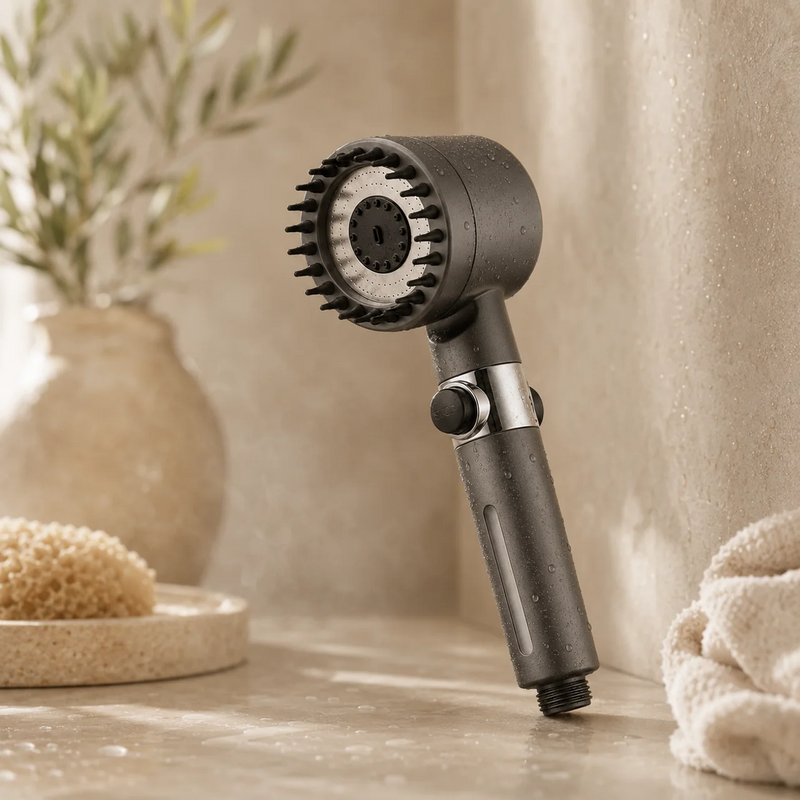
Ion Drop Filtered Shower Head
A filtered shower head that gives you a stronger, fresher-feeling rinse - with a replaceable PP-cotton filter that helps reduce chlorine taste and odour and fine...
Shop the Ion Drop · $74.99