How to Use a Hair Towel Wrap (Turban Method)
A hair towel wrap is the small, unglamorous swap that changes how your hair looks without adding a single step to your routine. It is also the one most people put on slightly wrong, which is why it slides off. Here is how to use one properly, and how to pick the right one for your hair.
How to wrap it, in four steps
- Squeeze first, do not rub. Gently press the worst of the water out with your hands before the wrap goes anywhere near your head. Rubbing wet hair against anything is what roughs up the surface and creates frizz.
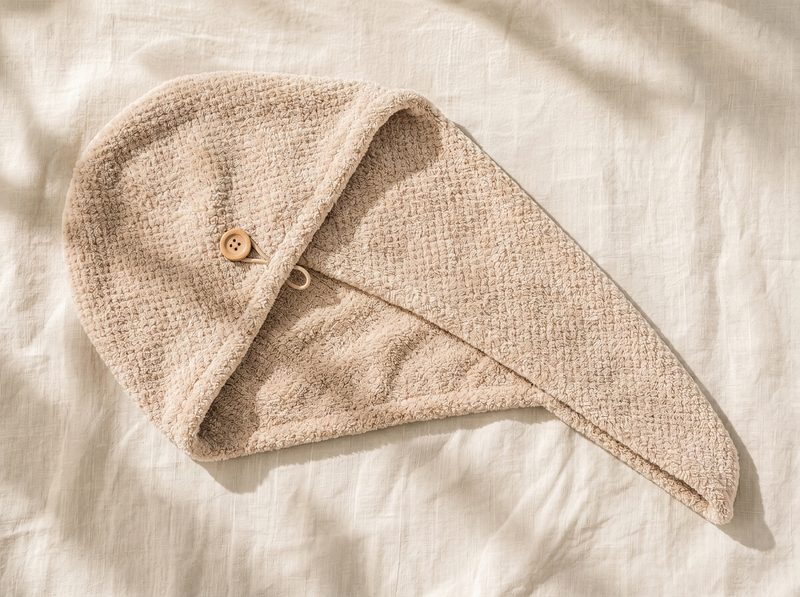
- Flip your head forward and lay the wrap at the nape of your neck, so the length of it falls forward over your hair.
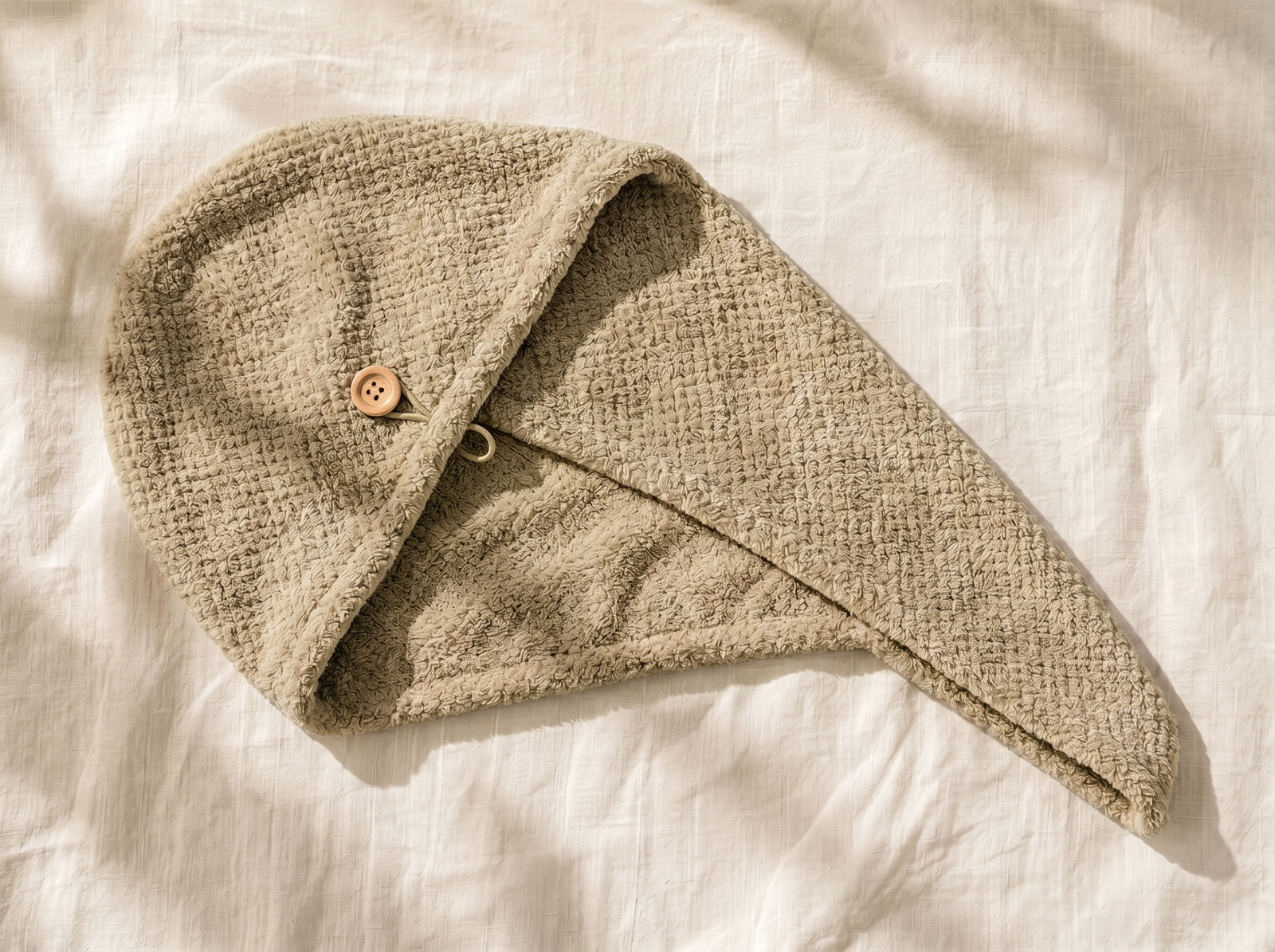
- Twist the tail, keeping gentle tension all the way down. A firm, even twist is what holds the wrap in place. A loose one is why it falls off five minutes later.
- Loop and button. Bring the twisted tail up and back, and fasten the button through the loop at the nape. It should feel secure without pulling at your hairline.
How long to leave it on
Ten to twenty minutes does the work. Microfibre pulls water out quickly, and past about twenty minutes you are mostly just wearing a hat. Leaving it on for an hour will not dry your hair faster and can leave it flatter at the roots than you wanted.
If you are heading for heatless curls, this is exactly the window you want, because those work best on hair around eighty per cent dry. There is a full walkthrough in how to use heatless curling ribbons.
Which wrap suits your hair
- Curly or coily. Microfibre is the standard advice over terry cloth here, because terry loops catch in the curl pattern and rough up the surface as you move. A smooth wrap lets curls dry in the shape they set in, so they look more defined and less fluffy.
- Fine hair. Weight is the thing to watch. A heavy bath towel drags on fine hair and on your neck. A light wrap holds itself up without the pull.
- Long or thick hair. Look for enough length in the tail to twist properly. If you cannot get a full twist, it will not stay put no matter how you fasten it.
- Colour-treated. Less friction is generally kinder to how colour looks over time. More on that in does chlorine fade hair colour.
Caring for it
Wash microfibre on its own or with other synthetics, warm rather than hot, and skip the fabric softener entirely. Softener coats the fibres and is the single fastest way to kill a microfibre towel's absorbency. Air-dry it or use a low tumble setting.
Hang it to dry between uses rather than leaving it bundled damp, and it will keep working for a long time.
Is it actually worth it?
Being honest about the size of the claim: a wrap does not change your hair. It changes how much friction and how much time your hair spends soaking wet, and both of those show up in how smooth and shiny it looks once dry. It also gets your hands free while it works.
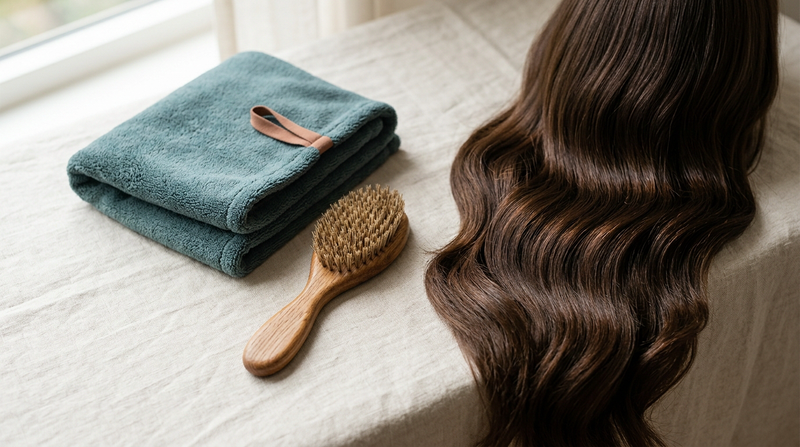
If you want the direct comparison with an ordinary bath towel, that is covered in microfibre hair towel vs a regular towel. The one described here is the Microfibre Hair Towel Wrap, and it pairs naturally with an anti-frizz detangling brush for the detangling step straight afterwards.
Turban method or plopping?
The wrap above is the turban method: hair twisted along its length and buttoned at the nape. It is the everyday one, and it suits any hair type that just needs the water out without the friction of a terry towel.
Plopping is the other way to use the same towel, and it is aimed specifically at curly and wavy hair. Instead of twisting the lengths, you pile them on top of your head so the curl clumps stay together while they dry. If you have curls you want to keep defined, that is the one to read next: how to plop your hair with a microfibre towel.
Does it work for curly hair?
Yes, and it is arguably where a microfibre hair turban earns its keep most. Terry loops catch the cuticle and pull curl clumps apart as they dry, which is exactly what makes curly hair look frizzy. A fine microfibre weave lifts the water out instead, so curls keep the shape they set in.
Microfibre or microfiber?
Same fabric, two spellings. Microfibre is the British and New Zealand spelling and microfiber is the American one, so a "microfiber hair towel" and a "microfibre hair towel" are the same thing. Either way it means an ultra-fine weave that absorbs water rather than scrubbing it out.
The Microfibre Hair Towel Wrap is made for both methods: it twists and buttons into a turban, and it is soft enough to plop into. Free shipping on every order.
Can you sleep in one?
You can, and plenty of people do, but it is not what a wrap is designed for. Hair dries fastest with air moving around it, and a wrap that is still damp after a couple of hours has stopped drying and started just sitting there. Overnight also means hours of pressure on the hair at the twist, which is the friction the wrap exists to avoid.
If you want to go to bed with wet hair, the better sequence is to wrap for fifteen to twenty minutes to take the worst of the water out, then take it down and let your hair finish in the open. If you sleep in one anyway, keep the twist loose and the button slack, and expect damp roots in the morning.
Can you curl your hair with a towel?
Sort of, and it is worth knowing the difference. Wrapping damp hair around a rolled towel and sleeping on it is an old heatless-curl trick, and it does produce a soft bend. What it does not give you is an even curl, because a towel is thick, uneven and hard to secure, so the hair sits at different tensions along its length.
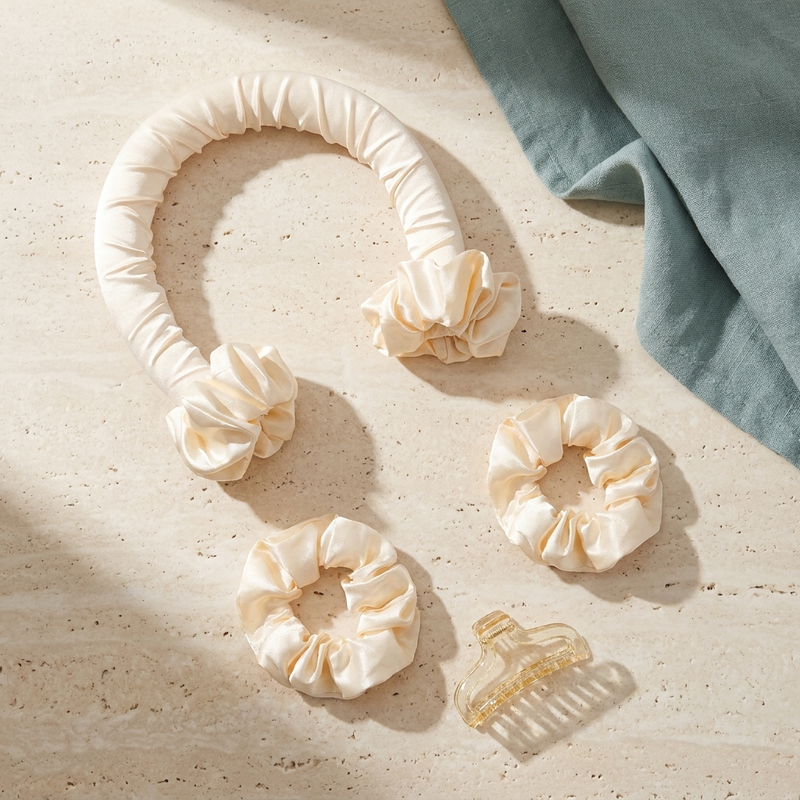
If curls are what you are after, a heatless curling ribbon is the tool built for it: a slim satin rod holds the same tension from root to end, and satin gives far less friction than towelling. Use the wrap for drying and the ribbon for shaping. There is a full method for the ribbons if you want to try it.

From the range
Anti-Frizz Detangling Brush
A quiet upgrade to the part of wash day everyone dreads. This flexible detangling brush glides through wet or dry hair, easing knots without the tug.Detangles...
Shop the Ion Drop · $27.99